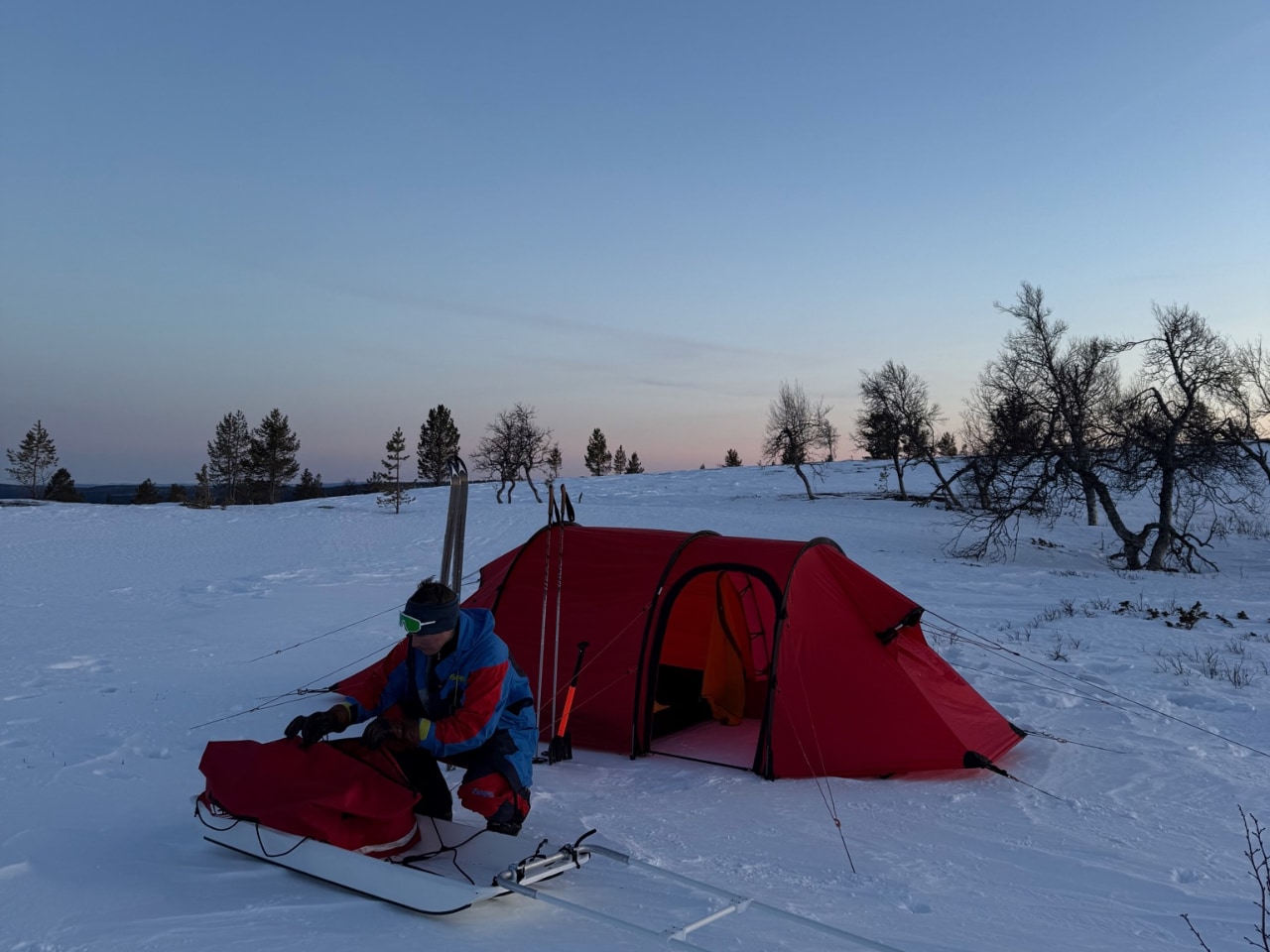
In the summer of 2023, I spent two months hiking 1640 kilometers along the Swedish mountain chain, from the Grövelsjön mountain station in the south to the point where the borders of Sweden, Norway, and Finland meet in the far north. This winter, I’ll be doing that trip again, but with my trail runners and backpack replaced with backcountry skis and a 35 kilo sled. The winter version of the adventure is called Vita bandet, or the White Ribbon in English.
An update from late January.
I decided to postpone my White Ribbon for a future winter season, but I’m leaving this blog post up in the hope that it’ll be a useful resource. I still plan on skiing almost every day this winter, but closer to home.
Like for the summer version, it’s up to you to decide which route to follow, as long as you remain in the fjäll region of Sweden and Norway. Since every White Ribbon follows a different path, the length and duration of the adventure varies from person to person. For the 18 people who completed the White Ribbon in 2024, the average distance was 1 292 kilometers, divided across 62 days on the trail on average.
When me and Rebecka moved to the Swedish fjäll in the fall of 2023, I had barely stood on a pair of skis since high school and had never been out winter camping. I suspected it wasn’t for me. Friends had told me that it’s harder work than summer camping and leaves little room for mistakes, especially when you’re out alone, and the amount of gear I’d need to buy was daunting. Still, I decided to give it a try in the forest close to our apartment on a not-too-cold night that January, with our summer tent and my new winter sleeping bag just barely fitting inside my backpack. I soon realized that I enjoyed hiking in the winter just as much as in summer. It’s more demanding for sure, but there’s nothing quite like pitching your tent on a meter of snow and being comfortable in your sleeping bag in temperatures as low as -30°C (-22°F).

I registered my adventure with Fjällfararnas Vita & Gröna band for the 2025 season, knowing that I would probably have to delay it to 2026 to have enough time to prepare, which is what ended up happening. In March this year, I instead did a 13 day ski tour of the Southern Kungsleden trail. In addition to testing my gear and routines, I wanted to make sure I would actually enjoy being out on my own on long trips in the wintertime, which I did. When the ski season was over (unusually early, due to a bad winter), I dealt with my post-hike restlessness as best I know how: By planning the next one.
Just like the Green Ribbon, the White Ribbon requires a ton of planning and preparations. You need to figure out your route, decide how to handle resupplies on the trail, and choose the countless pieces of gear you’ll depend on for transport, shelter, food and warmth in conditions including everything from storm winds in the freezing cold to thaws and rain. Fortunately for me, I love planning hikes almost as much as I love going on them. You can jump directly to the section you’re interested in through the links below.
As I’m writing this, my planned start date for the White Ribbon is four months from now, on February 8, 2026. You can follow my preparations on my Instagram, where I’ll also post daily updates from the trail when the adventure has begun.

The Route
Planning a route for the White Ribbon is in some ways a fools errand, since the route that looked doable from the comfort of your home office might be impossible due to the conditions on the trail on that particular day, like a snow dump, a sudden storm or an untimely thaw. Still, you need a planned route in order to estimate your supplies, so in addition to my main route, I have many, many backup routes for different sections of the trail.
For the Green Ribbon, my goal for the route was to avoid overlaps with my previous hikes in the Swedish mountains. I don’t need to worry about that for the White Ribbon, since I haven’t been anwyhere in the Swedish mountain chain north of my home county Härjedalen. Another difference from my Green Ribbon is that I’ll avoid travelling off-trail on the White Ribbon. Instead, I’ll stick to marked ski and snowmobile trails as much as possible. I’m not as experienced with long winter trips, I’ll be travelling solo, and going off-trail in winter is a lot tougher than in summer, so I don’t feel comfortable taking the road less travelled for this one.
I’ve mapped out my planned route in Gaia GPS, where it comes out to 1307 kilometers. You can find the route in its entirety here. The map layer I’m using can be seen through the Min Karta service, which is run by the national mapping agency Lantmäteriet. I’m planning on an average of 20 kilometers per day, including rest days, which comes out to an estimated 65 days or so. That estimate is bound to be incorrect, and even though I tend to do more kilometers than I’ve planned rather than fewer, I’ve taken an extra week off from work just in case.
For inspiration, I’ve looked at the routes used by previous white ribboners, which are listed on the Fjällfararnas Vita & Gröna band website.


Section 1: Grövelsjön – Storlien
Distance
171.3 km
Ascent
7 783 m
Ascent per km
45.43 m
Est. duration
9 days
My first four days on the trail will be almost identical to my last four days on Södra Kungsleden last year, taking me from Grövelsjön in Dalarna through the Rogen nature reserve to my girlfriends family cabin in Fjällnäs, Härjedalen. From Fjällnäs, I’ll go north over Långbrottfjället and down to the homestead Klinken, and then continue north to Storlien via the Fältjägarstugan mountain cabin and Helags, Sylarna and Blåhammaren mountain stations, which only have the unmanned emergency rooms open that early in the season. Fältjägarstugan and Helags seem to be the most common places for white ribboners to be trapped by snowstorms, so I’m hoping I’ll be lucky with the weather here.
Section 2: Storlien – Gäddede
Distance
258.1 km
Ascent
10 494 m
Ascent per km
40.66 m
Est. duration
13 days
From Storlien, I’ll continue north on snowmobile trails, first to the Skalstugan cabin, and then to the Anjan mountain station and Kolåsen mountain hotel. I’ll have a resupply box waiting for me at Kolåsen. Next, I’ll head east on snowmobile trails to the village Olden where I’ll hopefully get a chance to meet the Green and White Ribbon legend Stig at the village community center, and then turn north up to the town Valsjöbyn where I can resupply at the store. North of Valsjöbyn is the large nature reserve Hotagen, where snowmobiles are banned and there are no ski trails, so it’s likely to be a pretty tough crossing. My plan is to stay on elevation for as long as possible, following the route I used through Hotagen on my Green Ribbon along the Norwegian border, until I reach the northern edge of the nature reserve and ski down to the road leading to the town Gäddede. Pretty much everyone who’s doing the White or Green Ribbon pass through here.
Section 3: Gäddede – Hemavan
Distance
252.8 km
Ascent
7 406 m
Ascent per km
29.3 m
Est. duration
12 days
I’ll follow snowmobile trails over the lakes and mountains north of Gäddede until I’ve reached Klimpfjäll, where there’s a nice hotel and a store. I suspect I’ll take my first rest day either here or in Gäddede. From Klimpfjäll, my plan is to follow the Lapplandsleden trail all the way to Hemavan. I’ve heard some bad things about the elevation changes on the northern end of Lapplandsleden in winter, so I’ll play that section by ear and maybe go via Tärnaby if I grow tired of the climbs.
Section 4: Hemavan – Abisko
Distance
474.7 km
Ascent
16 500 m
Ascent per km
34.76 m
Est. duration
23 days
This is by far the section that I’m most excited about on my White Ribbon. The King’s Trail was my first experience with long-distance trails in the Swedish mountains when I hiked it back in 2021, and I’m eager to revisit it in the wintertime. I’ll follow the King’s Trail all the way from Hemavan to Abisko, passing through Ammarnäs, Jäckvik, Kvikkjokk, and Saltoluokta. The King’s Trail is a popular destination for international visitors, so I can expect to meet a lot more people on this section of the White Ribbon.
Section 5: Abisko – Treriksröset
Distance
169.8 km
Ascent
5 582 m
Ascent per km
32.87 m
Est. duration
11 days
After a rest day or two at the Abisko mountain station, I’ll start the final section of my White Ribbon by crossing the massive lake Torneträsk to the northeast. After that, I‘ll spend another week or so on the large fjäll to the east of the Norwegian border before I reach the Pältsastugan cabin, which is the northernmost building in all of Sweden. From there, it’s just another ten kilometers to Treriksröset where I will have completed my White Ribbon.
When the celebrations are done, I’ll need to ski another 15-20 kilometers to reach civilization in Kilpisjärvi, Finland. From there, I have a few days on busses and trains ahead of me before I make it back to our home in Härjedalen.

The Supplies
There are broadly speaking two approaches to supplies on long-distance hikes: Buy your supplies from stores on the trail, or prepare boxes with supplies before you head out and send them out to mountain stations, hotels and stores that you’ll pass along the way. For my Green Ribbon, I mostly relied on sending out supply boxes, so I decided that I would try the other approach on my White Ribbon and buy as much as possible on the trail. Each comes with their own set of pros and cons.
If you buy supplies from stores you pass on the way, you can buy whatever you’re in the mood for on that day, and only as much as you think you’ll need until you reach the next store. On the other hand, you’re limited to the selection of goods available at that particular store. That selection can be very limited, and is often poorly suited for cooking on the trail. Neither volume nor weight is as much of a limitation in winter, though, and you generally don’t need to worry about food going bad due to the low temperatures. Food freezing is a much bigger issue.
Sending food in supply boxes means that you can get pretty much whatever food you want, as long as it isn’t fresh. It’s generally cheaper to buy food at home than in the stores on the trail, even if you factor in the cost for shipping. The downside is that it’s hard to predict what you’ll be in the mood for a few months down the road, and how hungry you’ll be. If you don’t send enough food, you can almost always supplement from a store, but it seems to be more common that people send too much and have to carry the excess. I made that mistake on my Green Ribbon, and ended up leaving quite a few freeze dried meals that wouldn’t fit in my backpack in the kitchen at the Anjan mountain station. I hope someone found them useful.
Another thing to keep in mind: Buying food and fuel from stores, hotels, mountain stations and cabins on the trail is a good way to support them and help them stay in business. Without them there to sell supplies and receive supply boxes, the White and Green Ribbon would be a lot more difficult.
I’ll start my trip with about four days of supplies. That’s enough to get me to Fjällnäs, where I’ll have a supply box waiting for me at my girlfriends’ family cabin. There’s also a great grocery store nearby called Hamra livs. I’ll pass several mountain stations with small stores run by the Swedish Tourist Association in northern Jämtland, but too early in the season for them to be open. That means that the next open store I’ll pass will be the supermarket in Storlien, which is absolutely massive due to the many, many Norwegians coming there buy sweets, booze and tobacco, which are cheaper on the Swedish side of the border.
After Storlien, I won’t pass another store until I arrive in Valsjöbyn in another ten days or so. Instead of carrying ten days worth of food from Storlien, I’m going to send a supply box to the mountain station Kolåsen, which is only four days from Storlien. That will be the only box I send in the mail for my White Ribbon. On the rest of the trip, I’ll buy food from stores and mountain stations. You can find an extensive list of the stores and stations providing different types of services between Grövelsjön and Treriksröset on the Fjällfararnas Vita & Gröna Band website.
Getting enough calories in you is a challenge on any long hike, but especially in the wintertime, when the body has to burn extra calories just to keep the body temperature up. I failed pretty spectacularly at this on my Green Ribbon hike. I’d lost a ton of weight by the end of the hike, and struggled to stay warm at night as a result.
For the White Ribbon, I’ll be aiming for a daily intake of 4000 calories on days when I’m on trail, and a lot more when I’m staying indoors in the towns I pass on the way. This is what I’m planning on eating:
- Breakfast: Granola and powdered milk (~600 kcal)
- Lunch: Two 80 g flapjack (~750 kcal)
- Dinner: Freeze dried meals (~550 kcal), sometimes proper cooked food (with more than ~550 kcal)
- Snacks: Protein bars, dried meat, bierwurst, etc (~650 kcal)
- Dessert: Chocolate, candy, etc (~1500 kcal)
When in town, I’ll eat everything.

The Gear
When me and my partner Rebecka moved to the mountains two years ago, I didn’t own any gear designed for ski touring. No skis, no winter tent, no sled, no shovel – nothing. I’ve spent a lot of time, energy, and yes, money on ski touring gear since then. The benefit of knowing almost from the outset that I had a White Ribbon in my future is that I made every purchase with that in mind, so I wouldn’t make any good-enough-for-now purchases that I would later want to replace with different gear.
My first instinct after my experiences with ultralight backpacking gear in the summer was to go as lightweight as possible in winter as well, with a loadout built around bringing a backpack instead of a sled. There are plenty of YouTube hikers from North America successfully using UL gear in the winter, like Justin Outdoors, but they aren’t as commonplace in the Swedish mountains, where our low tree line means that winter storms can be extremely fierce. I abandoned my lightweight winter dream pretty quickly, and instead opted for a more traditional winter gear setup that’s been thoroughly battle tested in Swedish conditions. I decided that my loved ones are worried enough about my solo winter adventures without me being a lightweight winter gear trailblazer.
Instead of a backpack, I’ll be using a sled to transport my gear. You’re less weight sensitive when you use a sled, since you’re only feeling the weight when you’re pulling it on a flat surface or an incline. When you’re standing still or going downhill, the weight of the sled is on the ground instead of on your back. That doesn’t mean you can’t feel the difference between pulling 30 kilos and 60 kilos, though. I’ve looked at every item on my pack list with a critical eye and asked myself if it’s really needed, and if it is, tried to find the lightest item for the job that doesn’t sacrifice functionality, reliability, or safety.
Same as for my summer trips, I used the service Lighterpack to create a pack list and tally up the weight of every single item I’ll bring with me. You can find that list here. As I’m writing this, my planned base weight is around 29 kilos, and I expect the sled to generally weigh around 35-45 kilos when fully loaded with food and fuel. Enough to make you sweat and curse when going up a steep hill, but still a number that I’m happy with given the tent and sleep system.
For even more information about good gear for the White Ribbon, I recommend Johanna Öhrlings video about the setup she used. No English subtitles, sadly. For a video in English, check out Paolo Peraltas 3 hour walkthrough of his White Ribbon gear.
Transportation
I’m using a pair of Åsnes Nansen BC backcountry touring skis. They are 205 centimeters tall, pretty wide and quite heavy, but they give me better float on deep snow than skinnier models. They are fairly easy to turn for their size, and the steel edges help give me purchase on icy snow. Åsnes backcountry skis have a locking system for their brand of short skins called Skinlock, and I’ll have a pair of short skins in a nylon mohair mix on my skis for most of the trip. For the steep climbs, I’ll use traditional full-length climbing skins in mohair. For the really steep climbs, I take my skis off and walk in my ski boots.
Those boots are the Alfa Outback BC 2.0. They are warm and quite comfortable, but I still use two layers of socks and preventative blister tape to keep my feet happy and blister-free. The biggest selling point of the Outback for me is the convenience of the built-in gaiters which keep the snow out of my socks. My ski poles are an adjustable 2-section model from Åsnes called Combat, which I chose not for their eye-catching color or combat-worthiness but for the extra-wide 125 mm baskets. I haven’t had a chance to try the poles in snow yet, but they seem sturdy and lightweight and come with replaceable baskets, which was the main selling point compared to my old pair of ski poles.

Given the tent and sleeping bag I’m using (more on that below), a sled was really the only option for me. I’m using a 170 cm Jemtlander sled, with two 150 L sled bags and the Jemtlander expedition harness. The benefit of two sled bags over the traditional fixed chapel is that the bags are easy to move from your sled to your tent or into a mountain cabin. I used the Jemtlander last season as well, and even though it is big and pretty heavy, I found it to work well in most snow conditions. My only regret is that I probably would have been fine with the lighter 140 cm model with 200 L capacity.
I’ll also bring my go-to day pack, which is the Durston Wapta 30 liter backpack. Some people wear a backpack while skiing for items they want easy access to, but my Wapta will be packed most of the time since I sweat too much if I wear it while pulling the sled. I’m bringing it for day trips and for shopping in towns.
Shelter
My tent is a Hilleberg Nammatj 3 GT tunnel tent, which is part of Hillebergs Black Label series designed to withstand hurricane winds and heavy snowload. It’s a real tank of a tent, with a thick silicone-coated nylon fabric and three sturdy 10mm aluminium poles that give the tent its structure. I would have been fine with Hillebergs lighter Red Label version of the model, the Nallo 3 GT, but the sturdier materials give me a bit more confidence when camping above the tree line.

The “3“ in Nammatj 3 GT means that it’s a three-person tent – at least on paper. It would be a tight squeeze for three in the wintertime, but it fits two people without issues. It’s a palace for me all on my lonesome. The “GT” suffix stands for the large extended vestibule that comes in handy for melting snow and storing the sled bags. I definitely could have made due with a smaller tent, like the two-person version of the Nammatj, but the extra space will be welcome during all of the long evenings I’ll spend in the tent, and the weight penalty in going up a size is pretty small at 300 g. I also wanted a tent big enough for two people and two dogs for future winter trips, since I’m holding out hope that I’ll convince my partner to join me for one down the road. Hilleberg winter tents are worth the eye-watering price given the build quality and excellent consumer support, but I’m not planning on buying more than one of them.
I’m bringing ten 31 cm Hilleberg snow and sand pegs. When I’m tenting somewhere exposed, my skis can be used to secure additional pitching points. I’ll also use the Hilleberg sled pack, which allows me to store the tent on top of my sled with the tent poles partially inserted in the channels. It makes the daily task of pitching the tent and taking it down again easier and faster, especially when you’re alone. Highly recommended.
Sleep System
Temperatures of -20°C are common during Swedish winters, and they are sometimes as low as -35°C, so you need a sleep system that can keep you warm (or at the very least safe) in those temperatures. My sleeping bag is a discontinued model from Marmot called Col Membrain, which has a water resistant lamination and a comfort rating of -29°C. It’s a pretty heavy piece of gear at 2070 g, but it should see me through any temperatures the Swedish winter can throw at me. If things get really extreme, I can sleep in my down jacket and pants for some extra insulation and bring along a warm water bottle rolled up in a dry bag.

Beneath my sleeping bag, I have an inflatable Therm-a-Rest NeoAir XTherm NXT MAX Large sleeping pad, with an R-value (measurement of insulation) of 7.3. It’s tough to beat when it comes to ground insulation for really cold temperatures, and the extra width and rectangular shape of the MAX version adds some comfort when I use it with my bulky winter sleeping bag. I also bring a closed cell foam pad, the classic Therm-a-Rest Z Lite Sol, which I can add to my sleep system when it’s extremely cold. On most days I just use it as an oversized sit pad when I’m taking breaks, but it also doubles as an emergency pad if my inflatable NeoAir pops and I’m unable to repair it in the field.
A new item on my gear list for this season is something called an arctic bedding. It’s basically a huge storage pod for your inflated sleeping pad and sleeping bag that you keep secured to the top of your sled during the day when you’re skiing. When you’ve pitched your tent, you just move the bedding inside, unzip the lid, and you’re ready to go to bed. In the morning, you zip it back up and secure it to your sled when you’re ready to get moving again. It saves you a lot of time on inflating and deflating your sleeping pad and stuffing your sleeping bag into a dry bag, and it can also be used as a couch during the day. The problem with many arctic beddings is that they aren’t fully waterproof, which gets you in trouble on days with wet snow or rain, which are unavoidable during Swedish winters. For my White Ribbon, I’ll be using a new product from Exped called Dura Bedding, which is built for Scandinavian conditions with waterproof materials and sealed seams. On paper, it seems like it should be up to the task. It’s also pretty lightweight compared to many of the competitors at 990 g. It’s new for the upcoming winter season, so I’m looking forward to trying it out on my test trips ahead of the White Ribbon.
Cook System
The cook system is even more critical in the wintertime than in summer, since you depend on it not only for preparing meals, but also for melting snow. Most winter campers use multifuel stoves, often with gasoline, and for good reason. They’re fast, fuel efficient, and work well in low temperatures. I won’t be using one. Instead, I’ll bring an old fashioned alcohol/spirit stove. Gasoline stoves require regular maintenance and are prone to clogging, and often end up requiring repairs on long trips. In comparison, an alcohol stove is close to foolproof and would probably still be useable after a tank rolled over it. They’re also quiet, which makes for a more pleasant time in the tent when you’re done skiing for the day. For those benefits, I’m willing to put up with them being a bit slower and less fuel-efficient.

I’ll be bringing the classic Trangia B25 spirit burner, paired with the smaller size (27) Trangia windshields, and the FV21 stove pre-heater. You often hear people say that alcohol stoves don’t work in cold temperatures, but with the pre-heater, I’ve used the Trangia alcohol stove down to -30°C without issues. The fuel consumption does go up in temperatures that low. I’ve tried some lightweight snow melting pots in titanium, but I’ve decided to go back to the classic 2.5L Trangia camp kettle since it works better with the Trangia windshields. If only it had a proper spout. In addition to the kettle, I’m bringing a Trangia Duossal frypan for when there’s sausages on the dinner menu.
Safety
There are always risks when you’re out in the mountains, especially when you’re on your own, and those risks are amplified by low temperatures in the wintertime. Being conscious of them and making the right decisions for any given circumstance is more important than what safety equipment you have in your sled, but making the right decisions starts at home when you’re packing your sled bags.
One of the requirements for registering your White Ribbon with the organization Fjällfararnas Vita & Gröna Band is that you have to bring an emergency beacon. There’s not a lot of cell phone reception in the Swedish mountains and there’s rarely other people nearby, so the emergency beacon can mean the difference between life and death if you’re injured and unable to get back to civilization by your own steam. I have a Garmin Inreach Mini, which I will also use to track my location so my friends and family know where I am at any given time. For smaller injuries that I can treat myself, I have a first aid kit with plasters, bandages, medicine, and so on.
Bones are not the only things that can break when you’re on the trail, and I have spares for all the important gear. That includes an extra ski binding, spare baskets for the ski poles, and a repair section for the tent poles. My winter repair kit also has Tenacious Tape, duct tape, Therm-a-Rest repair patches, a sewing kit, steel wire, zip ties, seam grip, glue, extra guy lines for the tent, and more so I can repair my sleeping pad, sleeping bag, and clothes. My wintertime multitool is the Leatherman Skeletool CX, which has pliers, bits, and a decent sized blade.
No discussion of wintertime safety is complete without the shovel. In the unlikely event that your tent is ripped to pieces in a storm, you can create an emergency shelter by digging a bivouac if the snow is deep enough. A less dramatic and more commonplace usecase for the shovel to improve your comfort in the snow. I always dig a pit for my legs in the tent vestibule, so I can sit properly in the tent before bedtime. On sunny days you can also dig a “solgrop”, loosely translated to a sun pit, which is a hole in the snow where you can enjoy the warmth from the sun while sheltered from the wind. My shovel is the Mammut Alugator Ultra, which is a certified avalanche rescue shovel of a decent size that only weighs 395g.
Another piece of safety gear I’m bringing is a reuseable gel hand warmer from Lifesystems. I haven’t needed it on a trip yet, but it’s good to know it’s there if I ever feel like my fingers or toes are in danger of getting frostbite.
Electronics
I’m bringing two power banks of the same make and model: the Nitecore Summit 20000. The Summit is designed for low temperatures and comes with an insulation carrying bag. It has a preheating function that raises the temperature of the power bank before it starts charging, which Nitecore claims increases its available capacity compared to regular power banks. I write “claims“ because I haven’t done any comparisons of my own. I’ve been very happy with the Summit, but most people do fine with regular, non-preheating power banks in the wintertime as long as they warm them up a little with their body heat before they use them. I pair them with an Anker wall plug with two USB C outlets and two braided USB C cables from Apple, so I can charge them simultaneously. I also have a braided USB C to Firewire cable from Cable Matters for my Garmin Inreach Mini.
My headlamp is a Silva Explore 5, which has a maximum output of 700 lumen and also charges with USB C. If I was planning on doing a lot of skiing in the evenings I’d probably bring a stronger headlamp, but I’ll try to limit myself to skiing while the sun is up. On my start date of February 8, the sun rises at 8:18 and sets at 16:32 at Grövelsjön, so the days will be pretty short when I set off. I’ll also bring a small digital thermometer from ThermoWorks, which can tell me the lowest temperature of the past 24 hours. More for fun than for any practical use.
Another thing that I do for fun while I’m out on adventures is to photograph and film them for my Instagram. For that, I’ll be using my iPhone 16 Pro together with some sort of tripod. I’m choosing between the lightweight Joby TelePod Mobile (up to 56 cm) and the sturdier Joby Compact Light (up to 131 cm), and I’m leaning towards the latter despite it being more than 600 g heavier. It’s a luxury item, but if it makes documenting the trip easier and more fun, I think it’s worth it. If all else fails I suppose I can use it as a spare tent peg.

Conclusion
If you’re still reading this, I a) am shocked, and b) hope it’s been useful! If nothing else, writing all of this down has helped me review my plans yet again and make some more changes to my route and pack list. I’m sure I’ll keep making changes right up until I pack my sled bags and head off to Grövelsjön, four months from now. I can’t wait.